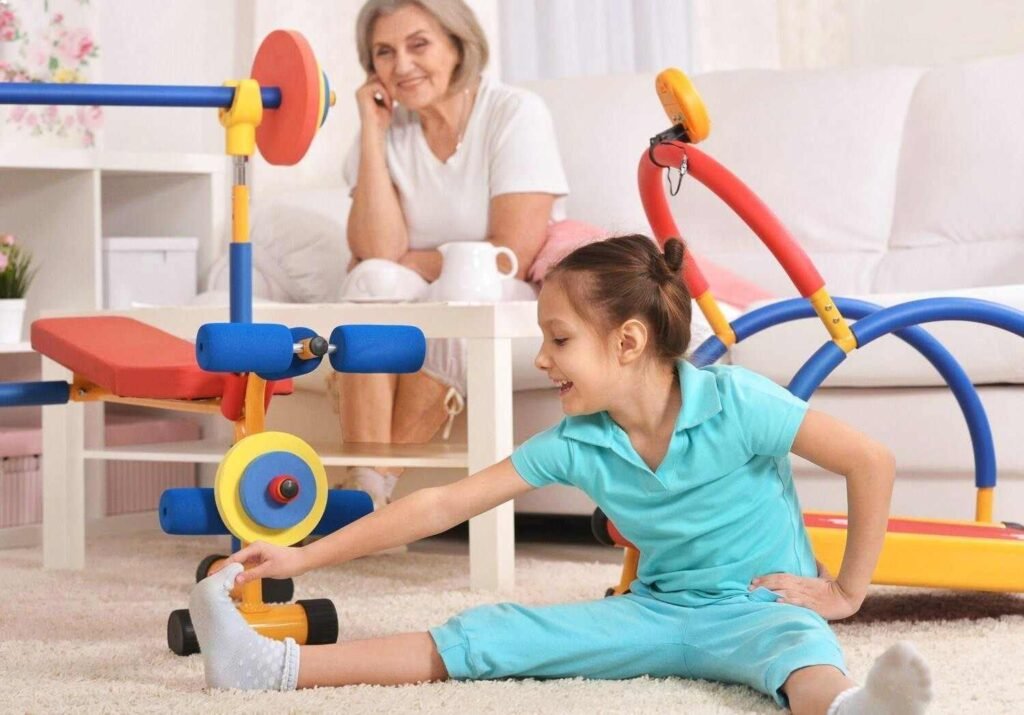
Choosing safety-certified children’s exercise equipment designed specifically for growing biomechanics helps young athletes build functional motor skills, cardiovascular endurance, and muscular balance without placing excessive stress on developing joints. Equipment engineered for youth activity such as adjustable resistance bands, mini obstacles, light medicine balls, and padded agility tools creates a foundational framework for lifelong physical health.
Designing Movement Environments with Specialized Children’s Exercise Equipment
Establishing a dedicated active play space requires selecting equipment tailored specifically to a child’s proportional strength, limb length, and coordination level. Standard adult workout gear is poorly suited for young bodies and can introduce unnecessary risk during movement execution. Incorporating scaled-down agility ladders, balance boards, and low-impact resistance tools allows children to explore physical movement safely while expanding their motor planning capabilities.
Creating dynamic training circuits keeps young participants engaged while promoting full-body physical development. Equipment that encourages multi-planar movement such as lateral hurdles, soft plyometric boxes, and jump ropes enhances spatial awareness and body control. When children interact with colorful, tactile fitness tools, daily physical activity feels less like rigid training and more like an exciting exploration of what their bodies can achieve. Parents can also focus on how to build lifelong healthy habits in kids for long-term physical wellness.
Integrating Structured Strength and Agility Gear for Young Athletes
Introducing progressive physical conditioning at an early age relies on equipment that prioritizes dynamic stability over heavy loads. Tools like light medicine balls, climbing ropes, and suspension trainers allow children to harness their own body weight to build core stability and muscular endurance. These movement patterns reinforce proper posture, joint alignment, and movement efficiency during critical developmental stages. You can also incorporate equipment into active birthday parties for kids centered around obstacle courses and energetic games.
       [ Dynamic Warm-Up & Mobility Gear ]
                       │
                       ▼
       [ Agility Ladders & Obstacle Hurdles ]
                       │
                       ▼
    [ Scaled Resistance & Bodyweight Gear ]
                       │
                       ▼
   [ Cool-Down & Balance Recovery Station ]
When structuring physical activities at home or in group settings, selecting versatile tools ensures balanced physical development across different physical skill sets:
-
Agility & Coordination Ladders: Floor-bound grids that improve footwork precision, reaction time, and cadence.
-
Weighted Medicine & Slam Balls: Low-weight, high-durability balls designed to develop rotational core power and coordination.
-
Soft Plyometric Steps: High-density foam platforms that enable safe jumping and landing mechanics without joint strain.
-
Bodyweight Resistance Bands: Elastic bands engineered with light resistance levels to teach smooth control through full ranges of motion.
Combining Digital Tools and Equipment for Dynamic Youth Workouts
Modern youth fitness approaches often combine tactile equipment with interactive digital formats to keep children motivated. Interactive movement platforms, guided workout routines, and physical feedback tools help kids track their progress in real time. Pairing physical gear with visual demonstrations ensures that exercise techniques are executed safely, reducing improper form while keeping sessions fresh and engaging. For structured agility and movement drills, join dedicated kids agility training classes cardio and agility training.
Interactive routines also encourage consistency by turning exercise into a goal-oriented habit. Children respond exceptionally well to visual benchmarks, whether that involves completing an agility course within a targeted timeframe or mastering a new movement pattern. Blending physical equipment with structured guidance builds confidence and reinforces positive habits that support long-term physical well-being.
Guided Instruction and Professional Supervision for Safe Equipment Usage
While high-quality equipment provides the physical foundation, expert guidance ensures that children perform movements with correct form and optimal safety. Certified fitness professionals specializing in youth development design age-appropriate circuits, correct posture faults in real time, and adjust equipment specifications to suit individual biomechanics. This structured oversight prevents movement compensations and builds a strong foundation for athletic performance.
Supervised sessions allow trainers to customize equipment usage based on each child’s unique developmental rate, preventing burnout and joint fatigue. Hiring a certified personal trainer for kids ensures one-on-one form guidance and personalized workout safety. Under structured supervision, children learn proper breathing techniques, dynamic warm-up protocols, and recovery strategies. This combination of specialized equipment and expert instruction empowers young athletes to move confidently, while complementary martial arts drills show how boxing builds confident mind in teenagers.
Real-World Application: Youth Fitness Equipment & Skill Progression Case Study
A community athletic facility integrated scaled youth fitness equipment into a 10-week conditioning program for 25 young participants aged 7 to 12. The curriculum utilized low-impact resistance bands, soft obstacle courses, and agility tools to measure improvements in balance, speed, and movement confidence.
+-------------------------------------------------------------------------+
|                  10-WEEK YOUTH SKILL PROGRESSION TIMELINE               |
+-------------------------------------------------------------------------+
| [Weeks 1–2]  Bodyweight Balance & Agility Ladder Mechanics              |
| [Weeks 3–5]  Light Medicine Ball Rotations & Obstacle Navigation        |
| [Weeks 6–8]  Resistance Band Posture Control & Speed Hurdles            |
| [Weeks 9–10] Integrated Circuit Execution & Performance Benchmarks     |
+-------------------------------------------------------------------------+
Post-program performance metrics recorded measurable advancements across key movement benchmarks:
-
34% Improvement in Balance Control: Participant performance on dynamic stability boards showed a significant reduction in postural sway.
-
22% Increase in Agility Speed: Time-trial results across multi-directional hurdle courses improved continuously without compromising landing form.
-
High Engagement Retention: 96% of enrolled participants maintained full attendance throughout the 10-week course, citing fun equipment variation as the primary motivator.
People Also Ask (PAA) Snippets
Is children’s exercise equipment safe for young kids?
Yes, exercise equipment designed specifically for children is safe when it uses scaled weights, low-impact resistance, non-toxic padded materials, and is utilized under proper adult supervision.
What equipment is best for developing kids’ strength and agility?
Agility ladders, light medicine balls, foam plyometric boxes, jump ropes, and soft resistance bands are ideal for developing youth strength, coordination, and athletic agility safely.
At what age can children start using exercise equipment?
Children as young as 5 or 6 can begin using basic movement gear like agility ladders and balance beams, while structured light resistance equipment can be introduced around ages 8 to 10.
How does youth exercise equipment differ from adult gym equipment?
Youth exercise equipment features smaller frame proportions, lighter resistance loads, padded safety surfaces, and non-adjustable mechanical leverage points tailored specifically to growing bodies.
Why is specialized equipment important for kids’ physical health?
Specialized equipment prevents joint overexertion, promotes natural biomechanical movement, builds foundational motor skills, and makes regular exercise fun and engaging for developing children.